
Tuesday, 25 May 2010
Swallow
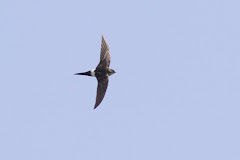
A photo of a Barn Swallow that I took a few days ago at Sydvestpynten. Despite their chirpy nature and very energetic flight, Swallows always look a little sad to me. Maybe in this case it's because the Danish spring isn't quite what he thought it would be!


Sunday, 23 May 2010
Marsh Warbler
Highlight this morning was a Lapland Bunting flushed from Kofoeds Enge that flew strongly north-east. Also seen were two Caspian Terns commuting back and forth along the shore at Sydvestpynten, a single small Diver (probably Black-throated), several Icterine Warblers, 4 Grasshopper Warblers along Kanalvej and a Marsh Warbler. Marsh Warblers are just arriving now, being one of the later arrivals in Denmark. The bird below has been present on Kanalvej for a couple of days and, as is typical with newly arrived birds, is quite showy. They are expert mimics and I could hear imitations of Swallow, House Martin, Great Tit, Redshank, House Sparrow, Starling, Icterine Warbler and Blackbird in its song. I am sure there are many more!
Photo: Caspian Tern
Video: Marsh Warbler

Photo: Caspian Tern
Video: Marsh Warbler

Saturday, 22 May 2010
Rosefinch
A warm night in mid- to late-May, coupled with misty conditions at dawn, always brings expectation - and usually no birds! However, for once, today that expectation was fulfilled with a Common Rosefinch at Sydvestpynten. I was a little late out today (Libby was flying to London this morning so, like the good husband that I am, I made her breakfast and helped her get ready). So it was good to meet Ole Nyegaard almost as soon as I reached Sydvestpynten who told me that there was a Common Rosefinch singing in the gardens by the car park. We walked over and could immediately hear it singing its characteristic wolf whistle-like song. After a few seconds we could see it in a birch tree and were pleased to see it was a nice red male (often one sees the rather drab first summer males). This bird had a red head, red on the upper breast and a red rump. I would think that this means it is at least a 3rd year bird (ie born at least two years ago). It was fairly mobile within the confines of the two gardens and sang almost constantly for the time we were there. I recorded a pretty grotty video and took a few photos (see below) before moving on to the point. On the way we bumped into Morten Christensen who had seen the bird earlier and he gripped us even more with news of a 'yellow' (ie adult male) Golden Oriole that he had seen migrating east from Kofoeds Enge - nice! I didn't score with the Oriole but did see 11 Honey Buzzards, a couple of Icterine Warblers, a Thrush Nightingale, 3 rather late Common Cranes, at least 30 Yellow Wagtails and a rather uncharacteristically showy Bittern that stood out in the open at Hejresøen.
Photo: 3k+ male Common Rosefinch, Sydvestpynten

Photo: 3k+ male Common Rosefinch, Sydvestpynten

Common Rosefinch from Terry Townshend on Vimeo.
Thursday, 20 May 2010
More Wood Warblers
A couple more photos of the Kongelunden Wood Warblers... they put so much effort into singing, their bodies literally quiver... I hope the females arrive soon!


Wednesday, 19 May 2010
Thrush Nightingale
It was very warm this morning - the first time I have not needed gloves first thing! There was no sign of the Common Nightingale at the fort but there was a Thrush Nightingale singing nearby.
On the subject of Nightingales, I recorded the showy Thrush Nightingale in Kongelunden this morning. And on this video you can even see the bird! Useful to compare with the song of Common Nightingale, although this individual didn't seem to display the full repertoire of the species.
Not much else to report - most of the flycatchers and Willow Warblers from a few days ago have moved on and there was very little visible migration at the point, the highlights being a single Caspian Tern and four Honey Buzzards.
On the subject of Nightingales, I recorded the showy Thrush Nightingale in Kongelunden this morning. And on this video you can even see the bird! Useful to compare with the song of Common Nightingale, although this individual didn't seem to display the full repertoire of the species.
Not much else to report - most of the flycatchers and Willow Warblers from a few days ago have moved on and there was very little visible migration at the point, the highlights being a single Caspian Tern and four Honey Buzzards.
Thrush Nightingale, Kongelunden from Terry Townshend on Vimeo.
Tuesday, 18 May 2010
The Invasion Begins...
Honey Buzzards are very common in Scandinavia and, during my time in Copenhagen, I have been lucky enough to see hundreds of these fantastic birds of prey. They are highly migratory, wintering in sub-Saharan Africa, and it is at migration time when they are most visible (they are very difficult to see during the breeding season). At this time of year they arrive back on their breeding grounds and my local patch of Sydvestpynten is a good place to watch them arriving on warm spring days. They do not rely completely on thermals to migrate and have no problem crossing stretches of water so, as soon as the weather warms up from mid-May, they set off. Many of the Honey Buzzards arriving at SVP have set off over the water from further south (from Stevns or Møns) and their journey across the water probably takes around 30-60 minutes depending on their starting point. Yesterday I was at Klydesøen early on a sunny morning (where, incidentally, the water levels are very high - not great for waders) and, at around 0940 I sighted 6 Honey Buzzards coming in off the sea... With the sun shining and the temperatures warming up nicely, I knew the migration was starting so I legged it down to SVP to watch them. In just over an hour (0950-1100) I counted 66 Honey Buzzards powering across the water with active flight and arriving at just a few metres height. They arrived on quite a broad front from Avedøre in the west to Dragør in the east but many came right over my head. A wonderful sight and one that tells us that summer is almost here....!
A large flock (60+) of Blue-headed (nominate flava)and the Fenno-Scandian subspecies thunbergi Yellow Wagtails in the horse fields were a nice end to the morning.
Photo: a newly arrived male Honey Buzzard

A large flock (60+) of Blue-headed (nominate flava)and the Fenno-Scandian subspecies thunbergi Yellow Wagtails in the horse fields were a nice end to the morning.
Photo: a newly arrived male Honey Buzzard

Monday, 17 May 2010
Wood Warblers
Thanks to Andreas for the comment on the "Sydlig Nattergal". With a second opinion from a respected birder, I am now confident it was a "Common" Nightingale. I hope it sticks around.
Over the last few days I have spent a little time watching the Wood Warblers in Kongelunden. I counted 6 singing males. Most of them were singing from high in the treetops but one seemed to favour the lower branches, offering superb views. I spent around an hour with this individual as it sang, oblivious to my presence... Definitely my favourite warbler!


Over the last few days I have spent a little time watching the Wood Warblers in Kongelunden. I counted 6 singing males. Most of them were singing from high in the treetops but one seemed to favour the lower branches, offering superb views. I spent around an hour with this individual as it sang, oblivious to my presence... Definitely my favourite warbler!


Sunday, 16 May 2010
Possible Common Nightingale, Sydvestpynten
I managed to get up early today and cycled down to Sydvestpynten to see whether the misty weather with easterly winds had caused an arrival of birds. A few Spotted Flycatchers, Garden Warblers and my first Icterine Warbler of the year was a good start. And then I heard a Nightingale sp singing. I immediately thought it could be a Common Nightingale ("Southern Nightingale in Danish) as, just a few minutes before, I had been listening to a Thrush Nightingale banging out its song as I cycled through Kongelunden. The Sydvestpynten bird sounded different - much softer and without the harsh sounds of the Thrush Nightingale. I recorded the song - see below. I am not 100 per cent sure it is a Common Nightingale (could it simply be a 'subsong' of Thrush Nightingale?) so I would welcome comments from anyone with good experience of the two.
Also seen was an incredible group of 6 Caspian Terns migrating east along the coast - possibly a site record.
Also seen was an incredible group of 6 Caspian Terns migrating east along the coast - possibly a site record.
Possible Southern Nightingale, Sydvestpynten from Terry Townshend on Vimeo.
Subscribe to:
Posts (Atom)



 Posts
Posts


