Saturday, 6 June 2009

A lonely woody

An early start to look for GREENISH WARBLER - a rare breeder and passage migrant - proved fruitless (my 'patch' at Kongelunden is a traditional spot for Spring migrants to turn up in early June). Also no sign of any FIRECRESTs but, after a couple of hours, I was enchanted by this Wood Warbler, singing low down in a clump of beech trees. He was singing his heart out and, as I sat and watched for over an hour, there was no female or indeed no other Wood Warblers at all in the vicinity. I felt for him. If only I could tell him that about 500 metres to the south, across the road, there are lots of his friends...

It was amazing how close birds came to me as I was sitting still.. first a Hawfinch came down to drink just a few feet from me, then a Honey Buzzard flew down from the canopy and briefly alighted on the forest floor before clocking me and scarpering, and then a Jay poked around just a couple of metres away and succeeded in finding an acorn (maybe one he had stashed away in the winter?).

Photos: a lonely Wood Warbler


Wednesday, 3 June 2009

Another 'red' day...

Two more new birds today - a smart drake Red-crested Pochard (220) and two Red-necked Phalaropes (221). Both species too distant to photograph but pretty damn good nonetheless... Much colder today with a brisk cold northerly wind and the occasional shower. I almost needed gloves - in June! The temperature, although predicted, came as quite a shock after the positively hot last few days when temperatures soared to 26 degs - it doesn't get any better than that in July and August! A short stint in the new hide at Vestamager (unfortunately badly positioned for viewing the waders) produced a few Redshank and a pair of Lapwing with chick. Plus this White Wagtail that performed very well just outside the hide.

Photos: White Wagtail


Monday, 1 June 2009

Bittern

With the weather forecast to turn distinctly cold mid-week (down to 13 degs from 27 today), I thought I'd make the most of the warm and still morning to get out again before work. The Grasshopper Warbler was reeling in the usual place on Vestamager and I was surprised to see an adult Lesser Black-backed Gull (not common in Denmark) in a boggy field, noticeably smaller than the argentatus Herring Gulls with which it was feeding.. The usual Marsh and Icterine Warblers were on territory and the Thrush Nightingales were making a right racket from the thicket (they really are loud). A short stop in the forest to listen for Golden Oriole proved fruitless as did a brief search of the "rosefinch" garden. At the Point the viewing conditions were excellent - a flat calm sea and crystal clear. It allowed a count of grebes offshore and I counted 16 Red-necked and 8 Great Crested. Two second calendar year Black-throated Divers flew west along the shore and this Bittern (see below) was doing its daily exercise routine, patrolling the reed beds. A squawk revealed that a Grey Heron had taken a fairly mature Coot chick and I could see the poor youngster's legs kicking violently as the heron flew off to feed with the parents in a futile hot pursuit. Not much else doing so back by 9 for breakfast...

Photos: Bittern


Sunday, 31 May 2009

Rosefinch

A beautiful day began at 4am with my cycle ride to Sydvestpynten where it was already warm with a light north-easterly breeze. A reeling Grasshopper Warbler was in its usual spot at Vestamager and Swifts were again around in good numbers. I stopped several times near the point to listen for birdsong and there were two Thrush Nightingales singing their hearts out. Then I heard the instantly recognisable 'wolf-whistle' song of a Common Rosefinch - fantastic. It sang several times from a garden by the car park but, despite scanning carefully with my binoculars, I could not see it. I tried moving around to change the angle but, despite knowing the precise shrub from which it was singing, it remained elusive. Then, after only a couple of minutes, I caught sight of it as it flew up and strongly north. Not the most satisfactory of sightings but a definite Common Rosefinch and my first in Denmark (219). A two-hour vigil at the point was rewarded with a few Brent Geese, a Bittern, singing Icterine and Marsh Warblers and a fantastic summer-plumaged Black-throated Diver that circled before heading off east towards the Øresund (the channel between Denmark and Sweden). After about 0800 it quietened down considerably so I spent half an hour photographing an obliging Marsh Warbler before heading home in time for breakfast!

Photos: Marsh Warbler; Black-throated Diver


Friday, 29 May 2009

A good day

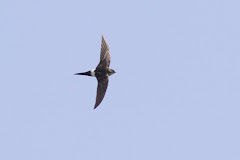
It's not often you get to see two new birds in one day. But today was one of those days. An early morning start at Kongelunden produced the expected Thrush Nightingale, Marsh Warbler and Icterine Warbler with the usual chorus of Reed Warblers chattering all around. Big numbers of Swifts were also passing through (at a rate of around 100+ per hour). Then, at about 0630, a trio of small birds caught my eye as they flew down into a grassy dip near the point. I knew that two of them were Linnets but the third looked smaller. I slowly worked my way towards the dip and soon got onto the birds as they fed on grass seeds. To my delight the third bird was a cracking bright yellow male Serin (217 for Denmark). The birds didn't hang around and almost as soon as I clapped eyes on them, all three flew off high north. I have seen many Serins over the years, mostly in southern Europe, but that was my first in Denmark and adult males are quite scarce here so that was a real bonus. Then, after checking the bushes around the point and seeing nothing but a few Willow Warblers, an Icterine Warbler and another Marsh Warbler, I headed back to my bike for the journey back. As I began to cycle a lone Crane flew over heading east towards Sweden and then I had to make the decision - straight back along the main road or slowly through the forest? I opted for the forest and I am very pleased I did. After about 200 metres I saw three birders all looking intently at the treetops. I stopped and they pointed saying "Pirol". Luckily my Danish was good enough to know that was a good bird - "Pirol" is Danish for Golden Oriole. It was quite vocal, singing regularly and also uttering its harsh Jay-like screech as it moved about high in the oaks. It took me a frustrating 30 minutes to see it and, even then, it was a pretty poor view, partially obscured by the foliage (hence the extremely poor photo below). It was a young bird due to its streaked underparts and greenish colour (unfortunately not the vivid yellow and black of an adult male) but, nevertheless, that was my first Golden Oriole in Denmark, too! 218 and counting....

Photos below: One of the Swifts passing through this morning; Arctic Tern; and a bunch of twigs


Thursday, 28 May 2009

Battle of Kruger

A friend told me about this incredible video of a real struggle involving lions, buffalo and crocodiles, taken in Kruger National Park, South Africa. Amazing drama and the best thing of all is that no animal dies....

Wednesday, 27 May 2009

Poll results

Thanks to all 5 of you for voting in the poll. I can now exclusively reveal the results... (drumroll)

In last place come 60 per cent of you (sounds better than 3) who thought that the top photo was a Reed Warbler and the lower photo a Marsh Warbler. SHAME ON YOU!!!

The winners (all 2 of you) correctly identified the top photo as a Marsh Warbler and the lower photo as a Reed Warbler. Well done.

It really wasn't easy as features such as primary projection, bill structure and length etc were difficult to compare given the angles of the photos. However, one feature is fairly obvious - the eye ring. Marsh tends to have a full pale eye-ring in spring which can clearly be seen on the top photo. Reed, although sometimes appearing to have a pale eye-ring, if you look closely you can see that the pale ring is only really pale under the eye. Marsh also tends to look a creamy colour on the breast and underparts with Reed a more brownish white. Very difficult to see and photos can mislead, depending on light conditions. This spring I have also noticed that the tail of Reed Warbler slightly tapers towards the end with Marsh being more square-ish. Not sure if this is a recognised feature or maybe just individual variation (my sample size is not huge). I will try to study more of them in the next few weeks...

Anyway, thanks for voting!

Friday, 22 May 2009

Icterines

Not much about today in a blustery two hour jaunt. The first Icterine Warbler of the year at Kongelunden was good to see and hear. The song is similar to Marsh Warbler with lots of mimicry but the Icterine includes a few characteristic whistles that allow identification on song alone. This morning's male was relatively showy, singing from the top of a hawthorn along a hedge. Other highlights included 3 Bitterns (including 2 in flight together) and a migrant Wheatear on the point.

Don't forget to vote in the poll below. Go on, don't be scared. It's completely anonymous so nobody will know if you got it right or wrong! :-)