I visited Sydvestpynten and Vestamager early this morning for the first time for a couple of weeks. Lots of new migrants now in with singing Grasshopper Warblers, Thrush Nightingales and Garden Warblers. A flock of 150+ migrating Barnacle Geese was good to see and there was a trickle of Yellow Wagtails and Tree Pipits flying overhead. Two Caspian Terns were a welcome sight - a pair of this scarce breeder has been seen now for around a week on and off at Vestamager/Kongelunden and, hopefully, they will stay to breed (probably on the nearby island of Saltholm). I bumped into Ole Nyegaard near Klydesøen and he told me he had seen a Red-breasted Flycatcher along Kanalvej at 0730 this morning. I had cycled along there at about 0545 but obviously I was still half asleep! I went back on the way home but, in 30 minutes of searching, I drew a blank. Sightings of this charming flycatcher are sadly very scarce in the Copenhagen area so it's a very good record.
One of the Grasshopper Warblers along Kanalvej was uncharacteristically showy and allowed me to video it singing from a fence right next to the cycle path - always fantastic to see and hear. If you listen carefully, as well as the Whitethroat, you may just here a Thrush Nightingale singing in the background. And at Kongelunden another Thrush Nightingale was similarly confiding whilst singing from a still largely leafless shrub - a great opportunity to study the northern cousin of the UK's Nightingale.
Since I have been living in Denmark I have heard so much about Skagen (the northern tip of Denmark) being a magical place in Spring for migration. It has a top class reputation and that is backed up by the records - Black-winged Kite, Bonelli's Eagle, Egyptian Vulture, Greater and Lesser Spotted Eagles, Steppe Eagle, Imperial Eagle, Three-toed Woodpecker, the list goes on and on. One look at a map tells you why Skagen is so good - it is effectively the northern tip of mainland western Europe and the narrow Skagen peninsula funnels northbound birds to the point at Grenen where birders wait with anticipation.
So when Henrik Højholm offered me a place to stay for a few nights in May this year, I jumped at the chance. As with most migration points, much is weather dependent and, unfortunately, my visit coincided with an unusual weather system that has meant that the winds have been predominantly from the north with very cold overnight temperatures - not the best for Spring migration. However, I thoroughly enjoyed the trip and saw some very good birds, too. Diver passage was a real highlight with well over 1,000 Red-throated Divers, several Black-throated and a probable White-billed which, for me at least, was just not seen well enough to clinch. We also saw a female Surf Scoter, two Dotterel and probably Denmark's last Crested Lark at the last-known breeding site in Hirtshals. A young (3 cal yr) Golden Eagle was fantastic to see attempting to migrate several times from Grenen and we found a 2nd calendar year male Montagu's Harrier (see below). A stunning male Lapland Bunting in summer plumage was a great sight coming in off the sea and despite the cold weather there were also reasonable numbers of some of the more common migrants including Wood Warbler, Pied Flycatcher, Redstart and, overhead, calling Tree Pipits and Yellow Wagtails were our constant companions. Raptor migration was disappointing (the eagle excepted) and the only falcons we saw were a couple of Kestrels (often at this time of year, especially in easterly winds, it is possible to see Hobbies and, if you are lucky, Red-footed Falcons). The stunning scenery makes Skagen all the more special and I hope I can make it back to experience it again in more favourable weather conditions.
I had fun putting together the video below - a summary of my visit to the tune of The Eels. Thanks to Henrik Højholm and Jimmy 'Skat' Hansen for their excellent company and for being my guides around this great site.
Photos: male Whinchat, Crested Lark and 2nd year male Montagu's Harrier
On my return to Copenhagen yesterday I read an astonishing story about Denmark's 14th ever Long-billed Dowitcher. This American wader has been present for several days at Lille Vildmose in Jutland (Jylland) and has been enjoyed by many Danish birders. Yesterday, whilst being watched by a few birders, the Long-billed Dowitcher was caught by a Sparrowhawk and eaten by a fox! A dramatic photo of the fate of the Dowitcher can be seen here.
I spent three hours in the north dunes on my last morning in Norfolk before returning to Denmark tonight. Winds were in the east and migration was almost non-existent with a handful of Swallows and a few Linnets. After an hour of very little I decided to check the rocks for a late Purple Sandpiper and was rewarded with two of these smart waders feeding amongst the surf. Fantastic. The Ring Ouzel remained loyal to its small field and two Cuckoos were engaged in a territorial battle with energetic "cuckooing" and rapid chases along the dunes, again providing fantastic photo opportunities. The underwing pattern is truly stunning and something I have not noticed before..
It's been an enjoyable few days back on my old stomping ground despite the cold north-north-easterly winds which have had a dampening effect on migration. With Woodchat Shrike, Purple Sandpiper, Cuckoo and lots of common migrants, it's been an enjoyable few days.
As it was my last full day in Winterton, I paid another visit to the Woodchat Shrike in the valley. It was much more active today in the sunshine, feeding well and ranging further than the impenetrable bushes it has been inhabiting over the last few days of cold and windy weather. I saw it catch at least two lizards, one of which it impaled on a thorn. Although these birds are very common in southern Europe, it really was special to see one in the area where I grew up learning my birding skills.
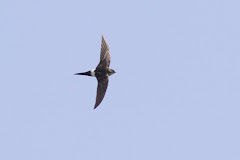
Another early start in much better conditions (a light north-easterly and sunny clear skies) was rewarded with much more migration today. Linnets continued to dominate the passerine migration but there were also good numbers of hirundines (mostly Swallows but also a few Sand Martins and, later, a sprinkling of Swifts and House Martins). Two Yellow Wagtails, a few Meadow Pipits, a Hobby, Common Scoter, Gannets and Guillemots provided the supporting cast. Highlight was a very confiding Cuckoo that came from the north and passed very close by along the top of the dunes. It settled on a nearby fence and called actively for several minutes before settling to feed. My first of the year.
Another early start in marginally better conditions (still a fairly strong north-easterly with occasional showers) produced a higher number of migrants today. Highlights included 2 Hobbies, 2 Ring Ouzels, 2 Yellow Wagtails, 4 Common Cranes and 392 Linnets (a heavy passage, particularly in May).
A few days in the UK with both sets of parents has given me the opportunity for a couple of days birding in my old stomping ground of Winterton-on-Sea in Norfolk. Unfortunately the weather has taken a turn for the worst with bitingly cold strong north-easterly winds and squally showers, some of which are wintry. The result has been very little migration. Luckily the weather has also meant that the star bird of the Spring so far in Winterton - a first summer male Woodchat Shrike - has stayed put, enabling me to catch up with a new bird for me for the parish.
Today I spent a few hours sheltering in the north dunes watching the few birds that were battling the winds to continue their migration north. A few Swallows seemed to enjoy the buffeting wind and 50+ Linnets chattered overhead. A single Ring Ouzel was feeding in a sheltered spot together with three Wheatears and a single Common Buzzard briefly took to the air before deciding better of it and returning to the shelter of the wood. Hopefully tomorrow will be better!





 Posts
Posts


